
Contents › 7. Communications
7. Communications
Every operation in chapters 4 to 5 ends with a public announcement. This chapter covers where each announcement is posted, what one looks like, who is copied, and where the result appears on the public website.
7.1 Announcement channels and who is copied
Three announcements go out on the path from Committee Specification to OASIS Standard, and all three follow the Special Majority Vote rather than preceding it:
- The Invitation to Comment that opens the candidate review.
- The Call for Consent announcement.
- The OASIS Standard approval announcement.
The vote itself carries no membership announcement, because the member platform emails the eligible voters when a ballot opens and again when it closes. A public review opened under chapter 6 uses the same Invitation to Comment, and there the announcement is the act that opens the review and starts the clock.
Each of the three has a fixed destination:
- The Invitation to Comment is posted to the all-members community on the member platform and published again as a news post on the public website.
- The Call for Consent runs in the all-members voting facility as an opt-out ballot in which each eligible OASIS Organizational Member at the time of the call is entitled to express consent, and it is announced to the same all-members community. Results of the Call for Consent are published to the membership and the TC within 7 days after it closes.
- The OASIS Standard approval announcement is written by the TC Administrator and posted to the all-members list by OASIS staff, alongside the deploy of the
ospackage.
Distribution method affects whether an announcement reaches members. Distribute member-wide through the community's web interface rather than by mailing it from the OASIS mailbox (Google Workspace), because a post submitted by email is silently dropped when the sender is not subscribed to that community. The legacy mailing-list host (lists.oasis-open.org) that used to carry TC and comment traffic is unreachable, and mail sent to it fails silently for roughly two days before bouncing, so an announcement sent that way appears to succeed for about two days before it bounces. Re-confirmed on 22 July 2026: the host still publishes a mail exchanger record and its mail port still does not answer.
Every public news post copies the marketing communications lead and the Chief Operating Officer. Where a notification is already going out, such as the note telling a chair a ballot has closed, the copy rides along in that message rather than arriving separately.
- Owner
- TC Administrator
- System
- the member platform, all-members community discussion; the all-members voting facility for the Call for Consent
- Permission
- posting rights on the all-members community
- Timing
- the post is live immediately and fans out to members from there; the Call for Consent is open at least 14 days
- Record
- the community post and its URL, recorded on the request ticket
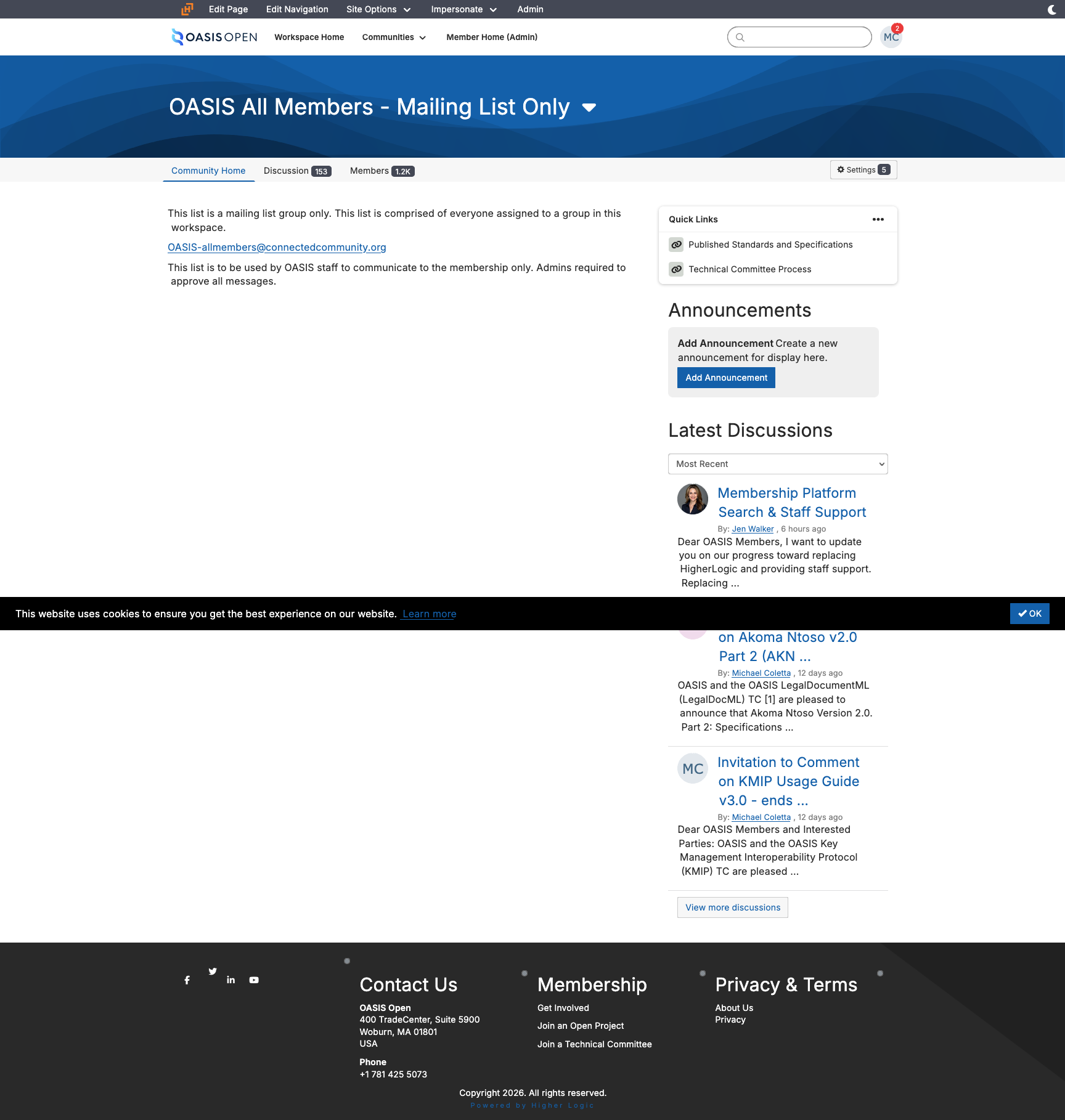
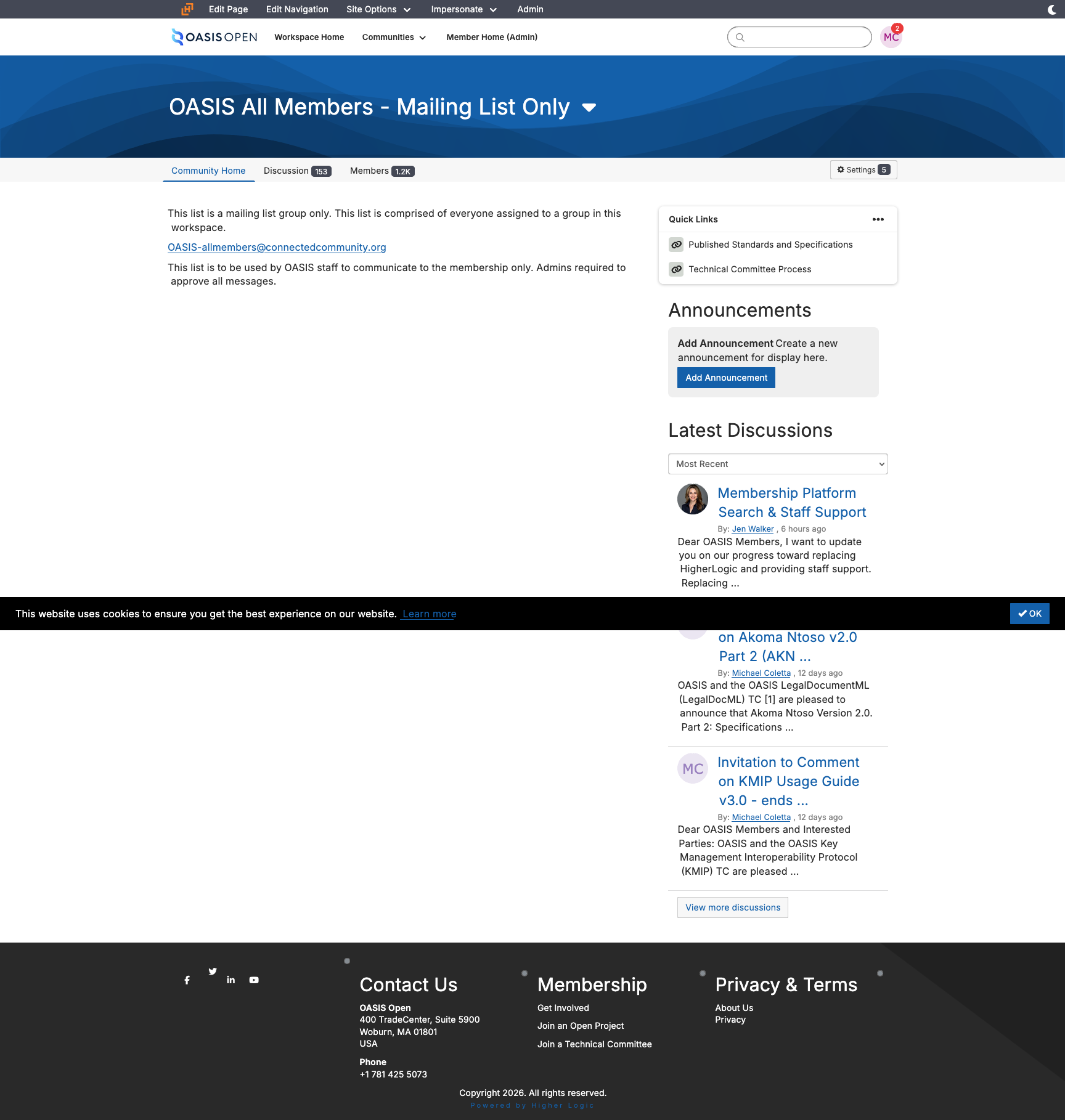
7.2 News posts on the website
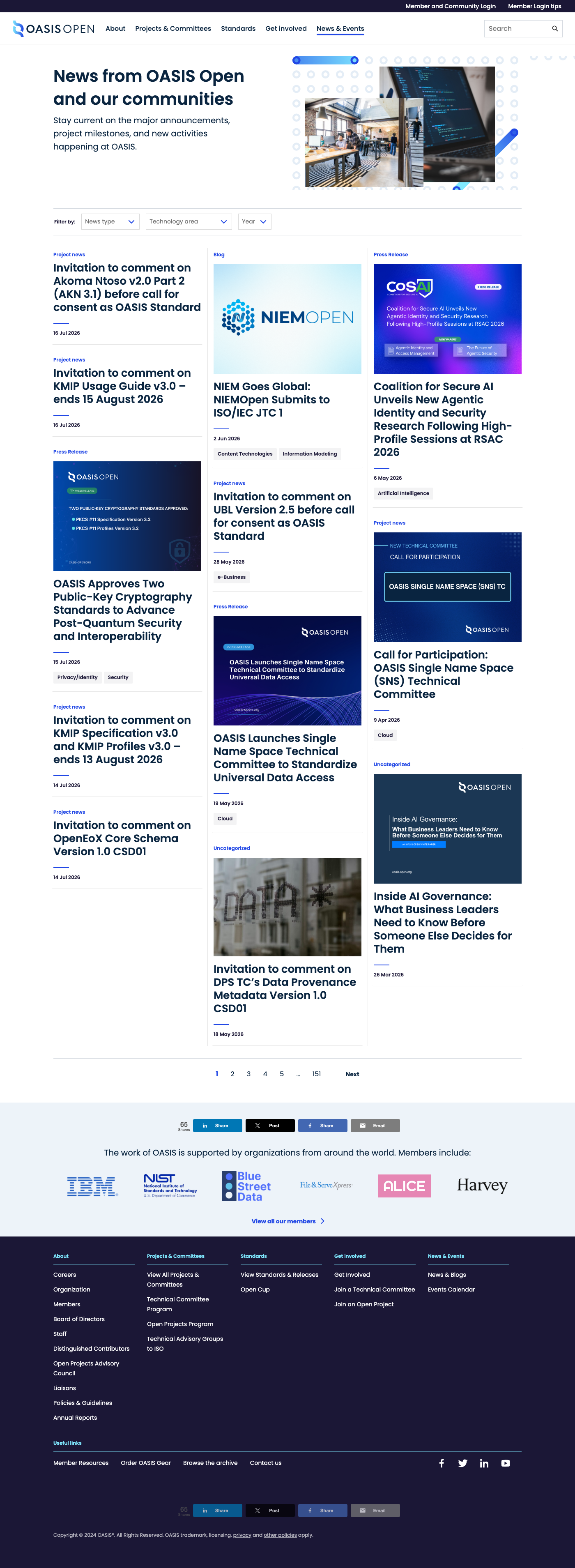
The public surface for all of this is the news feed on the OASIS website (WordPress, https://www.oasis-open.org). Announcements appear there as ordinary dated posts under www.oasis-open.org/news/, in reverse date order, mixed in with press releases and blog entries. There is no separate standards page and no standalone reviews index to maintain: a review is listed on the website by giving its news post the review category, and that post is the listing.
That listing method is currently broken, and the workaround described here is the current practice. As of 22 July 2026:
- the dedicated open-reviews listing URL returns not found;
- the category alias redirects to the news page with a filter parameter that the page ignores;
- the website has no category with that slug at all.
The four categories the news filter actually offers are blog, press release, project news and recent post, and every Invitation to Comment carries project news. So an announcement links the general news feed or the specific invitation post, never the open-reviews path.
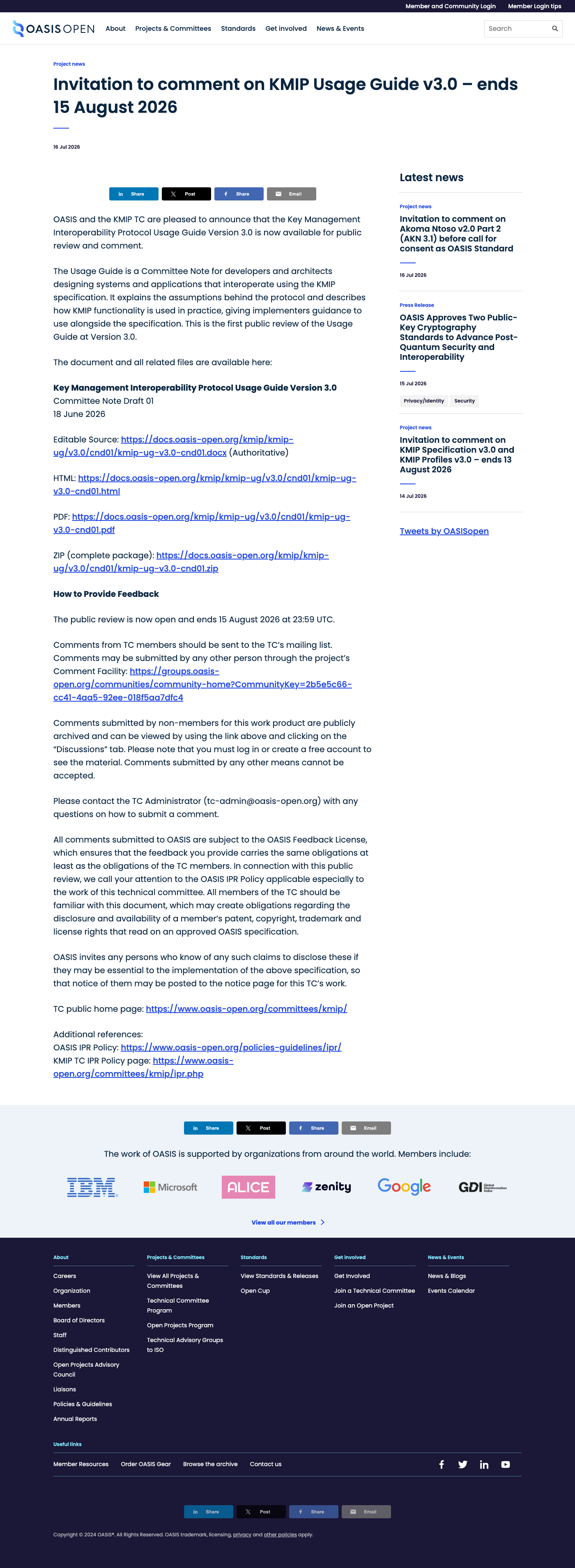
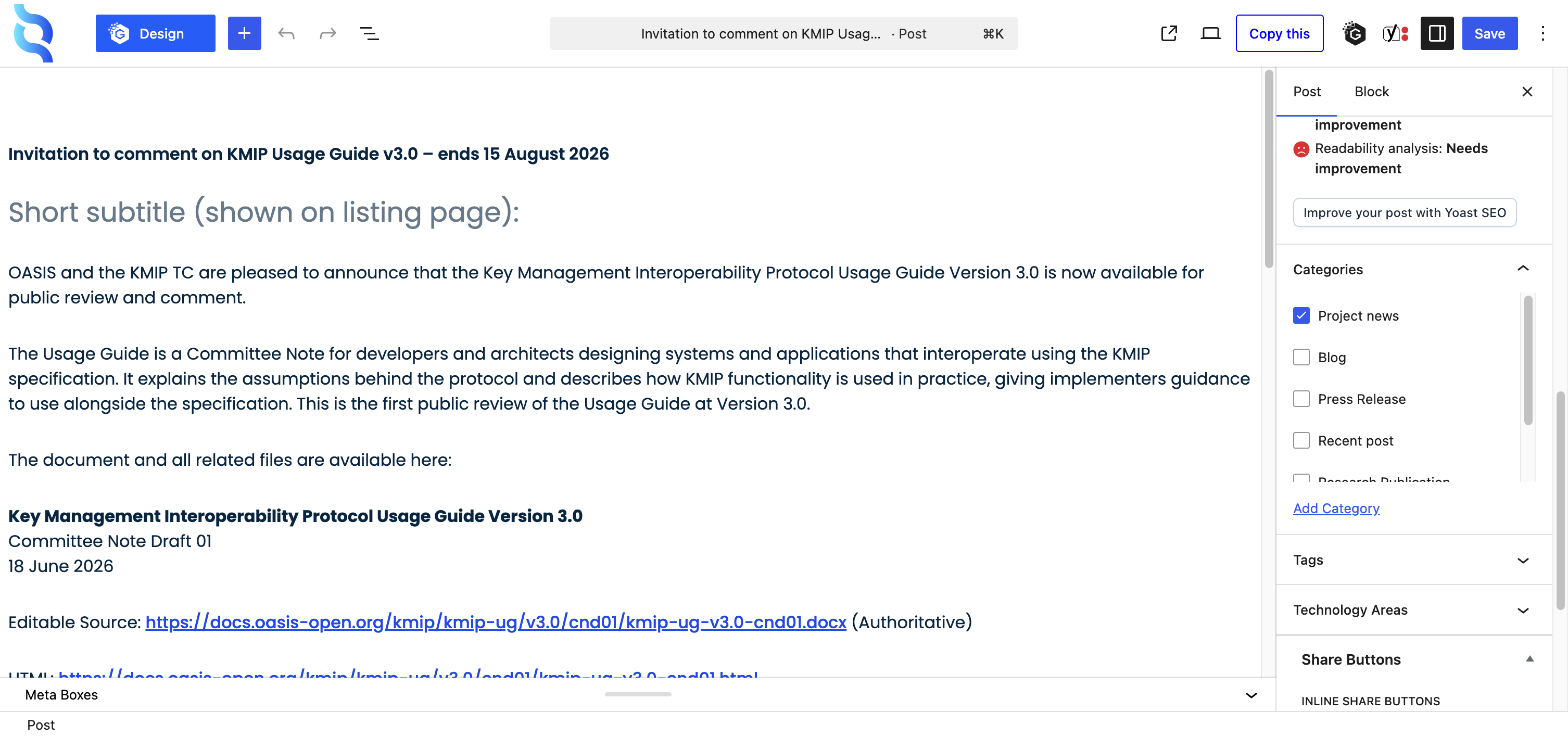
An Invitation to Comment post reads the same way whether it is on the member platform or the website. The title names the specification, its version and the closing date. The body has a fixed shape:
- opens with the TC and OASIS jointly announcing the review;
- one paragraph of TC-supplied description;
- a labelled link block giving the editable source marked authoritative, the HTML, the PDF and the complete package as separate lines;
- the review window with opening and closing times in UTC;
- the comment routing;
- the IPR policy references;
- the TC home page link.
The approval announcement follows a different shape, covered in 7.4. Live examples of both are on the feed: the KMIP Usage Guide v3.0 invitation posted 16 July 2026, and the two-standard PKCS#11 approval posted 15 July 2026, which carried the Specification and the Profiles at version 3.2 together.
The comment routing is stated in the post itself and is not optional wording:
- TC members comment on the TC's own discussion list;
- everyone else uses the public comment facility;
- comments submitted by any other means cannot be accepted.
- Owner
- TC Administrator drafts and publishes; the marketing communications lead edits or reposts
- System
- the public website's content management system
- Permission
- author access to the content management system
- Timing
- same day, from draft to published post
- Record
- the published post URL, circulated to the marketing communications lead and the COO

7.3 TC-facing email norms
A TC-facing email is a drafted deliverable with a set drafting process behind it. Nobody just types one and sends it. The draft goes through a fixed sequence:
- written against the whole thread and against real sent mail used as style examples;
- reviewed by a model other than the one that wrote it;
- reconciled so the operator's explicit instructions beat the reviewer's suggestions;
- given a second short review;
- staged.
Nothing is sent automatically. Every email is staged as a draft in the OASIS mailbox and a person sends it.
The tone rules are as binding as the drafting process. OASIS serves the TC, so an email:
- states what OASIS will publish and what it needs from the committee;
- offers recommendations with an explicit invitation to override them;
- never assigns tasks to TC members;
- understates ownership, frames it as interim rather than claimed;
- references a departed colleague at most once and neutrally.
Two content rules carry the most weight:
- Prove the negatives. Any negative claim, such as an announcement never having gone out, is confirmed against every mail folder and the live website news pages before it is written.
- Quote the clause. Any correction to a process-literate expert quotes the governing clause verbatim with its section, citing the TC Process in preference to the TC Handbook, because the Process is the document in force.
Formatting is part of the standard.
- Every staged draft carries a plain text part and an HTML part styled like a word-processor document, with bold lead-ins and real lists rather than an undifferentiated block of paragraphs.
- Any document attached to a TC-facing email is a rendered OASIS document that has been read visually before it is attached.
- Owner
- TC Administrator
- System
- the OASIS mailbox, drafts staged over IMAP
- Permission
- mailbox access
- Timing
- drafted the day the need arises; review and sending follow separately
- Record
- the draft, then the sent thread, referenced from the ticket
7.4 Announcing and promoting a finished publication
When a Committee Specification or an OASIS Standard is finished, its public announcement follows a fixed sequence, and the order is fixed for this reason: nothing is announced before the thing it announces is deployed and live.
- Deploy and confirm it is live first. The package is published to docs.oasis-open.org and confirmed live, and the deployed files are compared against the approved package before any announcement is drafted. A specification is an OASIS Standard the moment the Call for Consent closes clean, but it is not on the docs site until it is deployed.
- Announce to the membership. The approval announcement is posted to the all-members community on the member platform, naming the specification, its version and its OASIS Standard date, a one-line description of the TC, a plain-language paragraph of what the version adds, the Statements of Use named by organisation, and a link block to every published artifact, the authoritative source, the HTML, the PDF and the complete package, on docs.oasis-open.org.
- Post to the public website. A dated news post goes up on the OASIS website under the project news category, in the register described below.
- Release and amplify where the work warrants it. For a marquee standard the marketing communications lead schedules a press release and supplies the link and the social posts for the TC and its members to amplify, two to three days after the membership announcement.
The worked example is PKCS#11. PKCS#11 Specification Version 3.2 and Profiles Version 3.2 became OASIS Standards on 3 June 2026 when the Call for Consent closed with no objections; the all-members announcement went out on 13 July 2026 and the public news post and press release followed on 15 July 2026, once the packages were confirmed live.
The register is a deliberate choice per standard.
| Register | Length | Contents |
|---|---|---|
| Default publication notice | roughly 250 to 370 words | the approval date, the TC's own description of itself, one substantive overview paragraph saying what the version adds, the Statements of Use named by organisation, the labelled document links and a fixed closing congratulation to the TC |
| Full press release | 800 to 1800 words | a significance paragraph and quotes from the chair and named member companies |
The press release is discretionary and reserved for marquee standards, and its quotes are solicited from real people rather than written on their behalf.
Coordination beyond the sequence above is limited. The marketing communications lead issues the membership announcement, schedules the press release and edits or reposts the news posts, and the TC chair is given advance notice and confirms the release timing. Beyond the copy rule in 7.1, which copies the marketing communications lead and the COO on every public news post, and the shared drafting of news posts in 7.2, no formal press sign-off is recorded. [VERIFY] Until one is documented, the copy practice in 7.1 is the only coordination step for any release-day announcement.
The date question is where marketing and the operation most often disagree, because the operation's dates come from deployment records, not the approval date. Because the package is not on the docs site until it is deployed, a press release scheduled for the approval date points at a page that does not exist yet. Two to three days are built between the close and any announcement, and marketing is told that is what the padding is for. The wider forecast is longer than review close plus 14 days: measured intervals from review close to OASIS Standard were 17, 28, 29 and 56 days across four specifications, so nearly the whole spread sits in the administrative gap before the Call for Consent opens. A forecast built on those medians reflects the pre-ballot backlog time, not the operation's own turnaround. The companion figure, that the Call for Consent itself ran 12 to 15 days in every one of the four, is not settled and is not quoted to marketing until it is: 5.6 records what reproduces from the record and what does not. [VERIFY]
On a clean Call for Consent the package is published and the approval announcement is sent to the membership as one batch, which is why it is treated as part of the publication rather than a task that can wait. Treating the announcement as separate work increases the chance it is missed. PKCS#11 Specification Version 3.2 and Profiles Version 3.2 became OASIS Standards on 3 June 2026 when the Call for Consent closed with no objections, but the approval announcement to the membership was not sent at the time; it went out on 13 to 15 July 2026, roughly six weeks later, folded into the next batch. That gap is the reason the announcement is treated as part of the publication and not scheduled separately.
- Owner
- TC Administrator writes the announcement; OASIS staff post it to the all-members list; the marketing communications lead handles press
- System
- the all-members community, plus the website news feed
- Permission
- as 7.1 and 7.2
- Timing
- 2 to 3 days between Call for Consent close and any announcement or press activity
- Record
- the all-members post and the news post, both referenced from the ticket
7.5 The announcement types on the public record
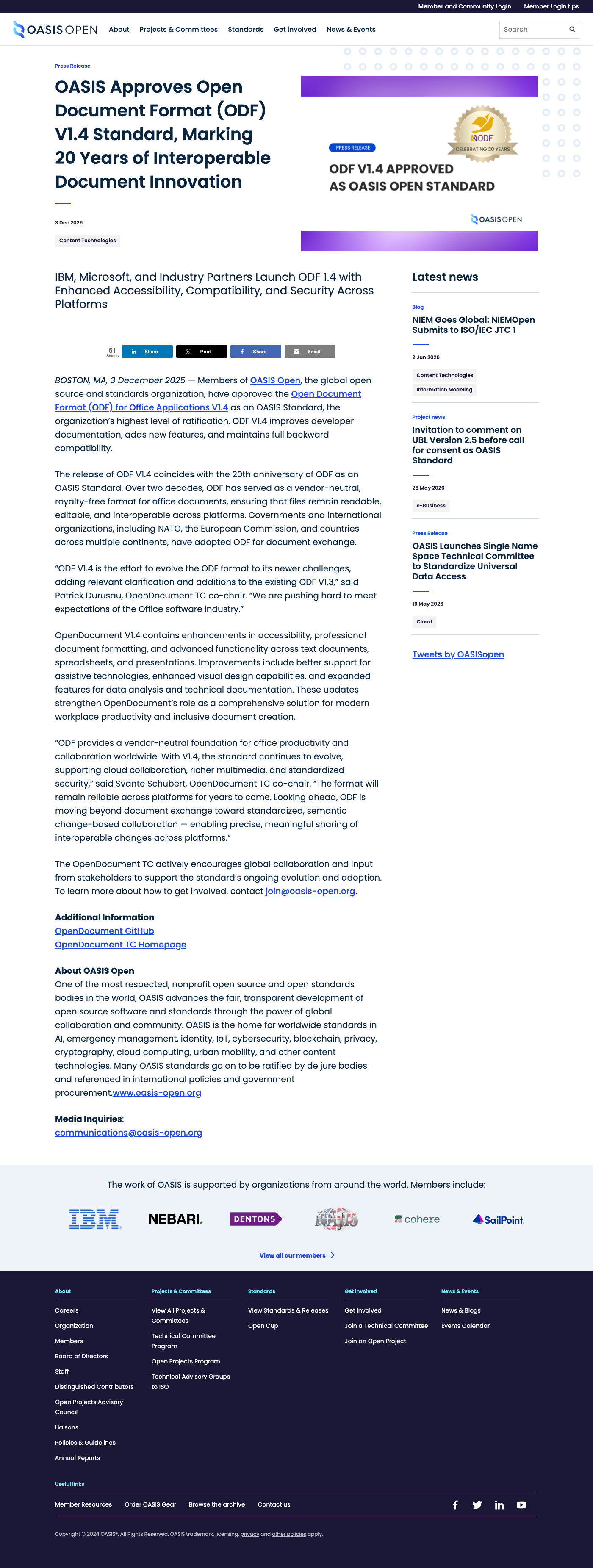
The publication and review announcements in 7.1 to 7.4 are the ones this operation writes, but they are a subset of what appears on the public feed. A successor scanning the news feed will meet at least eight recurring announcement types across the two years to July 2026. Each rides one of the four post categories: an approval or a launch is a press release, a review or a Committee Specification is project news. The examples below are real dated posts, none of them the PKCS#11 approval used as the worked example in 7.4.
| Announcement type | What puts it on the feed | A real example, 2024 to 2026 |
|---|---|---|
| OASIS Standard approval | a Call for Consent closes clean and the os package is deployed | OASIS approves ODF v1.4, 3 December 2025; TOSCA v2.0, 9 September 2025 |
| ISO/IEC submission or approval | a standard enters or clears the ISO/IEC JTC 1 route | CSAF v2.0 approved as an ISO/IEC International Standard, 20 May 2025; NIEMOpen submits to ISO/IEC JTC 1, 2 June 2026 |
| Committee Specification approval | a TC approves a Work Product as a Committee Specification | CACAO Layout Extension v1.0, 7 June 2024 |
| Public-review Invitation to Comment | a review opens and starts the clock | OpenDocument v1.4 before call for consent, 7 July 2025; XLIFF v2.2 CSD01, 9 September 2024 |
| New TC launch and Call for Participation | a new Technical Committee forms | Single Name Space TC, 19 May 2026; OEMF, 30 October 2025 |
| Milestone or anniversary | a standard reaches a landmark | CAP 20th anniversary, 7 October 2024 |
| Governance election | the membership elects the Board of Directors | Board election, 24 June 2024 |
| Recognition or award | a contributor or project is honoured | Distinguished Contributor Award, 15 August 2025 |
The point here is recognition. Most of these types are written by other people, but a successor reading the feed has to tell an OASIS Standard approval from a Committee Specification approval from a public-review invitation at a glance, because only the publication and review types in 7.1 to 7.4 start a clock this operation is accountable for.
7.6 Templates for the announcement at each stage
Four announcements go out on the path from a draft to an OASIS Standard, each with a reusable template, and a fifth template covers the Committee Specification approval that sits off that path. The ballot itself sends none: the member platform emails the eligible voters on open and on close, so there is no ballot-open announcement to write. The templates below are the working copy, reduced to placeholders in [SQUARE BRACKETS]. Fill every placeholder, and confirm every link works before posting, because a dead link in an announcement is a credibility defect on the public record.
The order the four path templates fire in:
- Public-review Invitation to Comment opens a first or subsequent review.
- Candidate-review Invitation to Comment opens the 60-day review after the Special Majority Vote.
- Call for Consent announcement opens the opt-out consent process.
- OASIS Standard approval announcement goes out with the deploy of the
ospackage.
The Special Majority Vote's own ballot text is not an announcement but it is a template too, and it lives with the ballot mechanics in 5.3. The request-ticket body that precedes a vote is in 5.3 as well.
1. Public-review Invitation to Comment. Posted to the all-members community and published as an open-reviews news post. The announcement is the act that opens the review and starts the clock.
Subject: Invitation to Comment on [SPEC SHORT] [VERSION] - ends [END DATE]

Dear OASIS Members and Interested Parties:

OASIS and the [TC FULL NAME] are pleased to announce that [SPEC TITLE] [VERSION]
is now available for public review and comment.

[ONE PARAGRAPH TC-SUPPLIED DESCRIPTION]

The documents and all related files are available here:

[SPEC TITLE] [VERSION] - [STAGE LONG], [DOC DATE]
- Editable Source (Authoritative): [DOCX URL]
- HTML: [HTML URL]
- PDF: [PDF URL]
- ZIP (complete package): [ZIP URL]

How to Provide Feedback
The public review starts [START DATE] at 00:00 UTC and ends [END DATE] at 23:59 UTC.
Comments from TC members should be sent to the TC's mailing list. Comments may be
submitted by any other person through the project's Comment Facility:
[COMMENT FACILITY URL]. Comments submitted by any other means cannot be accepted.
Please contact the TC Administrator (tc-admin@oasis-open.org) with any questions.

All comments are subject to the OASIS Feedback License. We call your attention to the
OASIS IPR Policy [1] applicable especially [2] to the work of this technical committee.

TC public home page: [TC HOME URL]
[1] https://www.oasis-open.org/policies-guidelines/ipr/
[2] [TC IPR URL]
2. Candidate-review Invitation to Comment. The 60-day review of a Candidate OASIS Standard, posted the same two ways. Same shape as template 1 with the candidate framing.
Subject: Invitation to comment on [SPEC TITLE] [CS-STAGE] before call for consent
         as OASIS Standard

OASIS and the [TC NAME] TC are pleased to announce a 60-day public review of the
above Candidate OASIS Standard.

Review period:  [START] through [END]  (minimum 60 days; give UTC times)
Specification and review materials:
  [candidate stage dir URL: docx (Authoritative) / html / pdf / zip]
Comment routing:
  - TC members: the [TC] general mailing list.
  - Non-members: the public Comment Facility ONLY. Comments submitted via any
    other channel shall not be accepted.
  Comment Facility: [comment-facility community URL]
IPR: governed by the OASIS IPR Policy
  (https://www.oasis-open.org/policies-guidelines/ipr/) and the Feedback License.
TC home page: https://www.oasis-open.org/committees/[tc]/
Contact: tc-admin@oasis-open.org
3. Call for Consent announcement. Posted to the all-members community when the consent ballot opens in the all-members voting facility. Its load-bearing content is the opt-out instruction: silence is consent, so an objection is the only action.
Subject: Call for Consent: [SPEC TITLE] [VERSION] as an OASIS Standard

OASIS Members,

The [TC NAME] has requested that [SPEC TITLE] [VERSION] (Candidate OASIS Standard,
[CANDIDATE STAGE URL]) be approved as an OASIS Standard. A Call for Consent is now open.

This is an opt-out consent process. Each eligible OASIS Organizational Member at the
time of this call is assumed to consent. To record an objection you must use the voting
facility before the call closes; an objection must carry a reason or a proposed remedy.

Voting facility: [CALL FOR CONSENT BALLOT URL]
Open: [START DATE] 00:00 UTC   Close: [END DATE] 23:59 UTC  (minimum 14 days)

Specification and complete package:
  [candidate stage dir URL: docx (Authoritative) / html / pdf / zip]

Results are published to the membership and the TC within 7 days after the call closes.
Questions to the TC Administrator (tc-admin@oasis-open.org).
4. OASIS Standard approval announcement. The house default is the publication-notice register: a fixed opening formula, the TC's own description of itself, one overview paragraph of what the version adds, the Statements of Use named by organisation, labelled links, and a closing congratulation. This is the real PKCS#11 v3.2 copy reduced to placeholders, and it is written for a single standard. Where one ballot approves two standards together, as the PKCS#11 Specification and Profiles were, pluralise the opening line and repeat the title block and the link block once per standard.
Subject: [OASIS Standard(s) Approved: SPEC TITLE(S) VERSION]

OASIS Members and other interested parties,

OASIS is pleased to announce the publication of its newest OASIS Standard, approved by
the members on [APPROVAL DATE]:

[SPEC TITLE] [VERSION]
OASIS Standard
[APPROVAL DATE]

[ONE PARAGRAPH: the TC's own description of what it develops]

[ONE PARAGRAPH: what this version adds, in plain language]

The TC received [N] Statements of Use from [ORG 1], [ORG 2], and [ORG 3].

The documents and all related files are available here:

[SPEC TITLE] [VERSION], OASIS Standard, [APPROVAL DATE]
Editable source (Authoritative): [DOCX URL]
HTML: [HTML URL]
PDF: [PDF URL]
ZIP of the complete set of files: [ZIP URL]

Our congratulations to the members of the [TC FULL NAME] on achieving this milestone.
5. Committee Specification approval announcement. Not every announcement is an OASIS Standard. When a TC approves a Work Product as a Committee Specification, the announcement rides the project-news register rather than the press register, and it is shorter than the OASIS Standard notice: there are no Statements of Use to name, because a Committee Specification is not a Candidate for OASIS Standard yet. The DMLex and CACAO Committee Specification posts in 7.5 are the model.
Subject: [SPEC TITLE] [VERSION] is now an OASIS Committee Specification

OASIS Members and interested parties,

The [TC FULL NAME] has approved [SPEC TITLE] [VERSION] as an OASIS Committee
Specification, [APPROVAL DATE].

[ONE PARAGRAPH: what the TC develops and what this Work Product is]

A Committee Specification is a stable, TC-approved deliverable. It may later be
submitted as a Candidate for OASIS Standard once Statements of Use are in hand.

The documents and all related files are available here:

[SPEC TITLE] [VERSION], Committee Specification [NN], [APPROVAL DATE]
Editable source (Authoritative): [DOCX URL]
HTML: [HTML URL]
PDF: [PDF URL]
ZIP of the complete set of files: [ZIP URL]

Our thanks to the members of the [TC FULL NAME].
These are working shapes, not the only ones: compare each template with the TC's own most recent post in the same class before reusing it, because a TC that has published before has a house phrasing of its own, and the 7.5 examples span several TCs on purpose.
- Owner
- TC Administrator drafts each announcement; OASIS staff post it to the all-members community.
- System
- the member platform, all-members community and voting facility; the public website for the news post.
- Record
- the posted announcement and its URL, recorded on the request ticket.